Scaling Wealth with Equity: How $100K Can Control $500K in Real Estate
Nov 04, 2026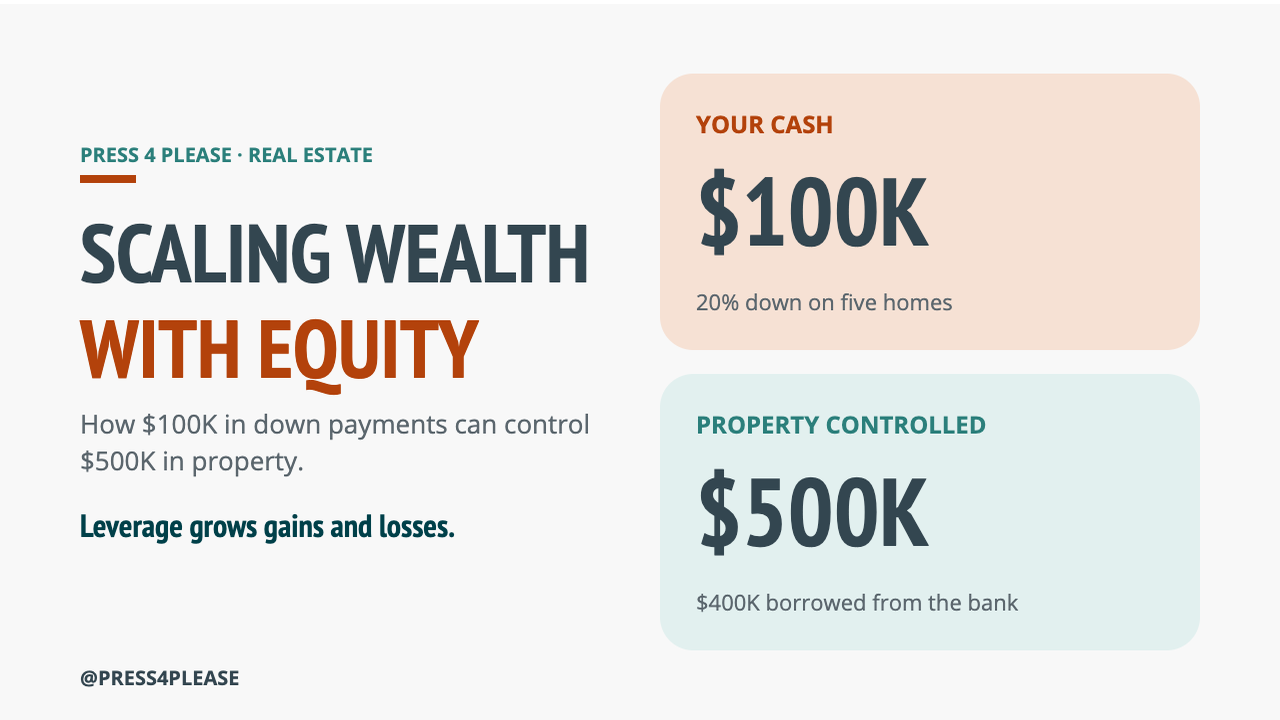
Here's a question that trips up a lot of new investors: if you have $100,000, should you buy one home in cash or use it as down payments on five? The second option is called leverage. It's one of the most powerful tools in real estate, and one of the riskiest.
What leverage means
Leverage means using borrowed money to control a bigger asset than your cash could buy on its own. In real estate, your down payment is your starting equity, and a mortgage covers the rest.
How $100K controls $500K
- Start with $100,000 in cash.
- Put 20% down on five $100,000 homes. That's $20,000 down on each.
- Borrow the rest. Each home has an $80,000 mortgage, or $400,000 in total.
- Now you control $500,000 in property. Your cash controls five times its value.
Putting 20% down also means you won't pay private mortgage insurance on a conventional loan. The $100,000 home price keeps the math simple. The same ratio works at any price.
The upside
Say home values rise 5%.
- One home in cash: $100,000 grows to $105,000. You gain $5,000, a 5% return on your cash.
- Five homes with 20% down: $500,000 grows to $525,000. You gain $25,000, a 25% return on the same $100,000.
Same cash, five times the gain. That's why investors use leverage.
The downside
Now say values fall 10%.
- One home in cash: it drops to $90,000. You lose $10,000, or 10% of your cash.
- Five homes with 20% down: they drop to $450,000. You lose $50,000, or half your cash. And you still owe the full $400,000.
Leverage magnifies losses just as much as gains. If values fall and you need to sell, you can lose most of your down payment.
These examples are simplified. They leave out rent, mortgage payments, interest, taxes, insurance, repairs and selling costs, which all change your real return.
What lenders look for
- A bigger down payment: loans on investment property often need 15% to 25% down. For example, Fannie Mae allows up to 85% financing on a one-unit investment home and 75% on two to four units.
- A higher interest rate: investment loans usually cost more than loans on a home you live in.
- Cash reserves: Fannie Mae generally requires six months of payments in reserve for an investment property, plus extra reserves if you own other financed properties.
- Enough income: you have to qualify for every mortgage you add.
Before you scale
- Run the numbers on each property. Rent should cover the mortgage, taxes, insurance, repairs and some empty months.
- Keep a cash cushion. One big repair or a long vacancy can strain every property you own.
- Grow at a pace you can handle. Five properties means five sets of tenants, repairs and bills.
The takeaway
Leverage lets a down payment control a much bigger asset. Used carefully, it can scale your wealth faster. Used carelessly, it can scale your losses. Treat it as a tool, not a shortcut.
Follow @press4please for more simple money lessons.
Numbers are simplified for illustration. Loan guidelines vary by lender and change over time. This article is for general information only and isn't financial advice. Talk to a licensed professional before you invest.
Want a head start?
Grab the free zero-based budget spreadsheet: give every dollar a job before the month starts.