Risk Assessment Matrix: How to Decide If a Money Risk Is Worth It
Oct 28, 2026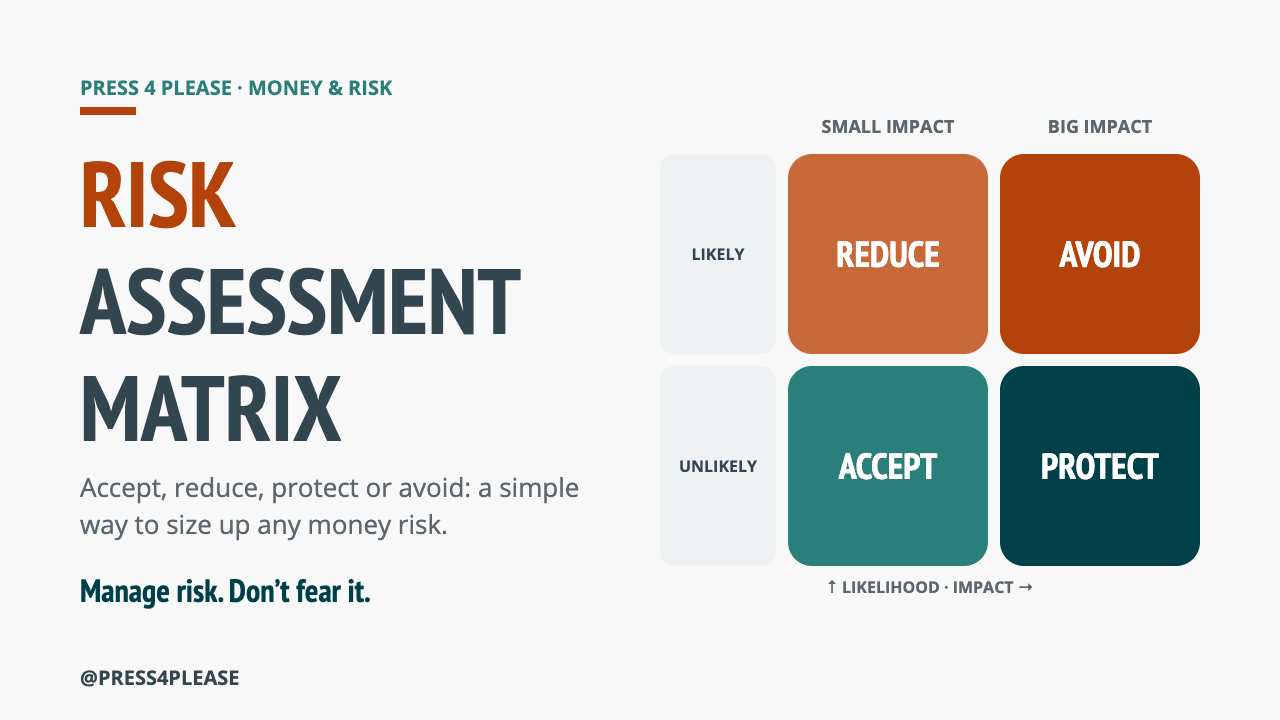
Should you skip the extended warranty? Keep that old car? Take out a loan to cover a gap? Every money decision comes with some risk, and not every risk deserves the same reaction.
A risk assessment matrix is a simple tool businesses use to decide what to worry about. It works just as well for your personal finances.
How the matrix works
Ask two questions about any risk:
- How likely is it? Likely or unlikely to happen.
- How big is the impact? A small hit you could absorb, or a big one that would knock you off track.
Those two answers put the risk in one of four boxes, and each box has its own move.
Accept: unlikely + small impact
Small costs that rarely happen. A minor price increase, a lost umbrella, a small repair on something cheap.
Your move: let it go and cover it from your monthly budget. Don't overpay to protect against it. Extended warranties on inexpensive items often cost more than the risk they cover.
Reduce: likely + small impact
Small costs that keep coming back. Car repairs on an older car, rising grocery prices, subscription creep.
Your move: plan for it. Give these costs their own line in your budget or a sinking fund, and save a little each month so they never catch you off guard. Review the category monthly.
Protect: unlikely + big impact
Rare events that could wreck your finances. Losing your job, a serious illness, a car accident, a house fire.
Your move: transfer the risk and build a cushion.
- An emergency fund covering 3 to 6 months of essential expenses
- Health insurance, auto insurance, renters or homeowners insurance
- Disability insurance, which protects your income if you can't work
This is exactly what insurance is for: rare disasters you can't afford to pay for yourself.
Avoid: likely + big impact
Choices that are likely to go wrong and expensive when they do.
- Payday loans. According to the CFPB, a typical two-week payday loan with a $15 fee per $100 borrowed works out to an APR of almost 400%.
- Betting rent or bill money on gambling or speculative investments.
- Cosigning a loan you can't cover if the borrower stops paying.
Your move: walk away and look for safer options, like a payment plan, a credit union loan or help from a local assistance program.
How to score any money risk in 4 steps
- Name it. What exactly could go wrong?
- Rate the likelihood. Is it likely or unlikely?
- Rate the impact. How much would it cost you if it happened?
- Pick your move. Accept, reduce, protect or avoid.
Try it on 4 real risks
- A $2 streaming price increase: unlikely to hurt and easy to absorb. Accept.
- An older car that needs repairs: likely but manageable. Reduce with a monthly car fund.
- Losing your job: unlikely but costly. Protect with an emergency fund.
- A payday loan to cover bills: likely to trap you in fees. Avoid.
The takeaway
The goal isn't to avoid every risk. It's to match your response to the risk: accept small, rare costs, budget for the likely ones, insure against big surprises and walk away from the rest. Manage risk. Don't fear it.
Want a simple place to start? Grab our free zero-based budget template, and follow @press4please for more simple money lessons.
Payday loan APR example per the Consumer Financial Protection Bureau (CFPB). Insurance needs vary by person. This article is for general information only and isn't financial or insurance advice.
Want a head start?
Grab the free zero-based budget spreadsheet: give every dollar a job before the month starts.