Renting vs. Buying: Which Builds More Wealth?
Oct 19, 2026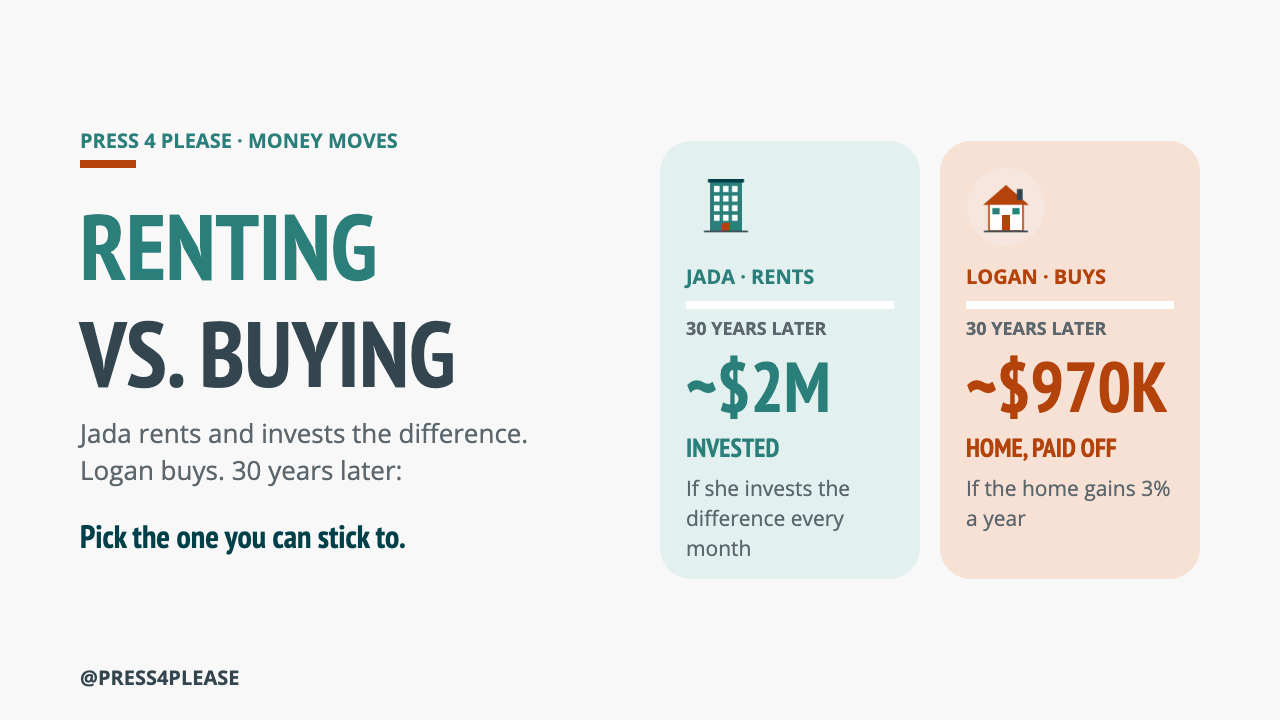
"Renting is throwing money away." You've probably heard it. But is it true?
Let's follow two people with the same savings and the same monthly budget for 30 years.
Meet Jada: she rents and invests
- Rents in the city for $2,200 a month to stay flexible
- Invests her $80,000 in savings on day one
- Invests the $1,095 a month she doesn't spend on owning a home
Meet Logan: he buys
- Buys a $400,000 home with $80,000 down
- Pays about $3,295 a month for the mortgage, property taxes, insurance and upkeep
30 years later
Jada has about $2 million invested. She put in about $474,000 total, grown at 7% a year, roughly the stock market's long-run average after inflation.
Logan owns a home worth about $970,000, paid off, if it gains 3% a year.
On paper, renting and investing wins. But that's not the whole story.
What the math leaves out
- Rent goes up. Rent usually rises every year. A fixed-rate mortgage payment doesn't, so Jada's monthly gap shrinks over time.
- Discipline matters. Renting only wins if you actually invest the difference, every single month, for decades.
- Owning has real perks. No landlord, a stable home, the freedom to renovate, and no housing payment in retirement.
How to decide
- Compare the full cost of owning, not just the mortgage: taxes, insurance, HOA fees and repairs.
- Don't stretch to buy. Keep an emergency cushion after closing.
- Renting? Automate investing the difference so it's not optional.
- Buying? Plan to stay put for years. Buying and selling costs add up fast.
The takeaway
There's no single right answer. The best choice is the one you can stick to, and the one that keeps your money growing either way.
Want a simple place to start? Grab our free zero-based budget template, and follow @press4please for more simple money lessons.
Hypothetical example. Assumes rent and owning costs stay flat, a 7% annual investment return and 3% annual home appreciation. Returns are not guaranteed. This article is for general information only and isn't financial advice.
Want a head start?
Grab the free zero-based budget spreadsheet: give every dollar a job before the month starts.