Opportunity Cost: What Did That Trip Really Cost?
Oct 22, 2026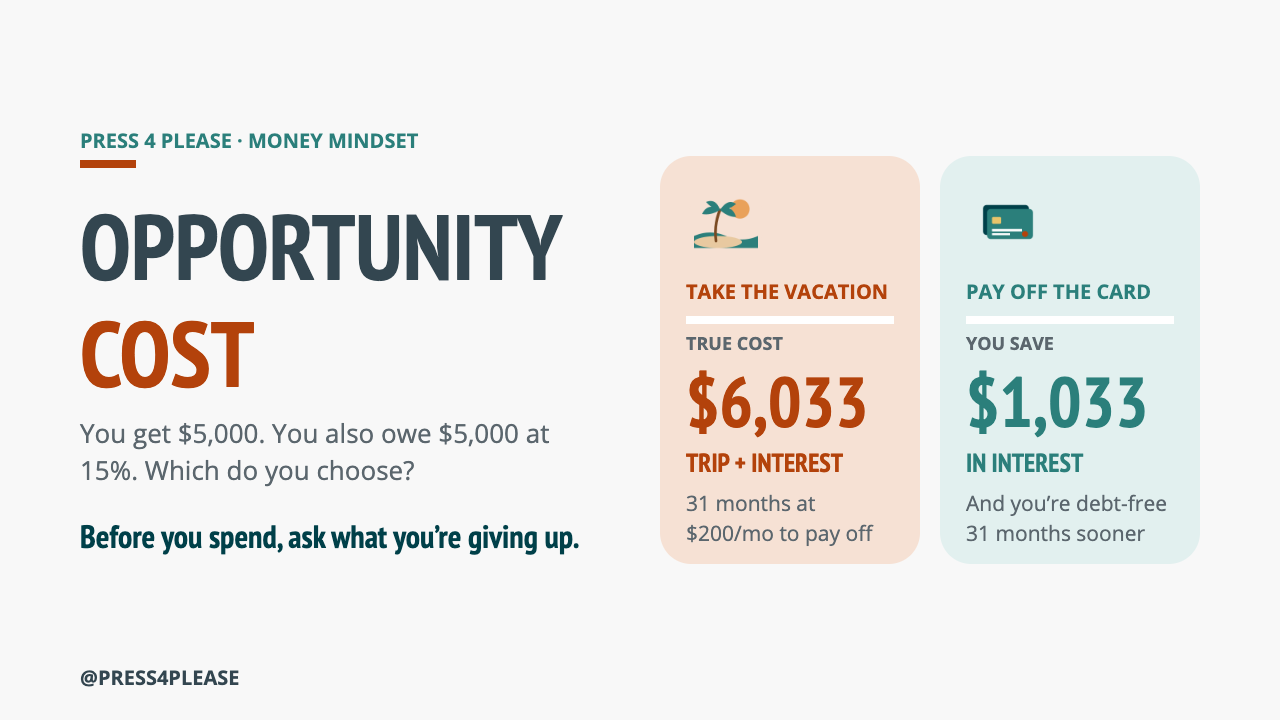
Every time you spend money, you're also choosing not to do something else with it. That hidden trade-off has a name: opportunity cost.
What is opportunity cost?
It's the value of the next-best option you give up when you choose something else. You see it everywhere:
- Spending a bonus vs. paying off debt
- Buying a new car vs. investing the difference
- Takeout every night vs. a fully funded emergency fund
The setup
You get a $5,000 bonus or tax refund. You also owe $5,000 on a credit card at 15% APR. You can only pick one.
Choice A: take the vacation
- The $5,000 goes to the trip.
- The $5,000 card balance stays.
- At $200 a month, it takes about 31 months to pay off.
True cost: about $6,033, the $5,000 trip plus about $1,033 in interest.
Choice B: pay off the card
- The balance is gone today.
- You never pay that $1,033 in interest.
- The $200 a month you were paying is free to save for the trip.
You save about $1,033, and you're debt-free 31 months sooner. Save that $200 a month and you can take the same trip in about two years, paid in cash.
How to use opportunity cost in real life
- Pay off high-interest debt first. Paying off a 15% card is like earning a guaranteed 15% return.
- Before you spend, ask: what am I giving up? Compare the next-best option.
- Plan big purchases with cash. Saving first means you're not paying interest on your fun.
- Remember that small choices compound too. A daily habit can be a big opportunity cost over a year.
The takeaway
The vacation isn't the problem. Paying 15% for it is.
Want a simple place to start? Grab our free zero-based budget template, and follow @press4please for more simple money lessons.
Assumes a 15% APR and $200 monthly payments; interest figures are approximate. This article is for general information only and isn't financial advice.
Want a head start?
Grab the free zero-based budget spreadsheet: give every dollar a job before the month starts.