Linear vs. Residual Income: Are You Trading Time for Money?
Oct 16, 2026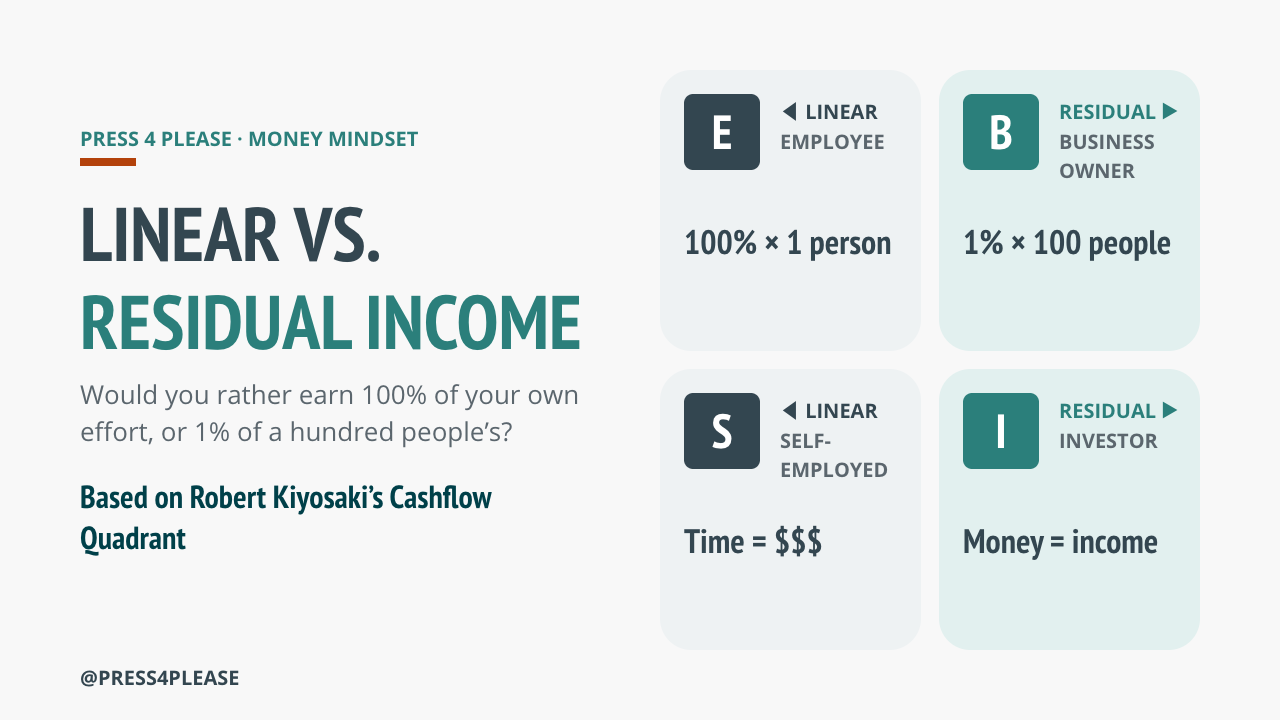
Would you rather earn 100% of your own effort, or 1% of a hundred people's?
Most of us never get asked that question. We're taught to get a good job, work hard, and trade our hours for a paycheck. There's nothing wrong with that. A steady paycheck pays the bills, and for most people it's where every money journey starts.
But if a paycheck is your only income, there's a catch: the day you stop working, the money stops too. That's the difference between linear income and residual income, and understanding it can change how you think about your next move.
If you've been laid off, you're not alone
Let's be honest about the moment we're in. Layoffs are everywhere right now. In just the first week of October, HubSpot announced it's cutting about 660 jobs, roughly 7% of its workforce. Paramount closed its $110 billion merger with Warner Bros. Discovery, and the new company's leaders have already said job cuts are coming. And Disney is reportedly restructuring its TV business, with hundreds more jobs expected to go.
That's a lot of talented, experienced people hitting the job market at the same time, and the layoffs aren't slowing down. More competition for every opening means finding your next job may take longer than it used to.
If that's you, take a breath. A layoff is not a verdict on your worth or your work. It's a business decision, and it's happening to great people at great companies. But it is a reminder of something important: when all of your income comes from one paycheck, one decision you didn't make can stop it overnight.
Why more than one income stream protects you
Additional sources of income won't make you layoff-proof, but they change what a layoff does to you:
- A softer landing. If a side business or investments bring in even a few hundred dollars a month, losing a paycheck doesn't take you to zero.
- More time to choose. Extra income stretches your savings, so you can hold out for the right job instead of grabbing the first one out of fear.
- Less risk in one place. One employer means one point of failure. Several streams spread that risk out, the same way a diversified investment portfolio does.
- A head start. The skills, customers and systems you build on the side are yours. No one can lay you off from them.
That's what this post is about. Not panic, and not "quit your job tomorrow." Just a clearer picture of how income works, so you can start building something that's yours.
What is linear income?
Linear income is money you earn in direct exchange for your time. Work an hour, get paid for an hour. Stop working, stop getting paid.
Examples:
- An hourly or salaried job
- Freelance work billed by the hour or project
- Overtime and extra shifts
- Most service work you do yourself
Linear income isn't bad. It's reliable, and it's usually how you build the savings and skills you need for everything else. The limit is simple: there are only 24 hours in a day, so there's a ceiling on what you can earn.
What is residual income?
Residual income keeps coming in after the work is done, because a system or your money is doing the work instead of you.
Examples:
- A business with a team or process that runs without you being there every hour
- Investments that pay dividends or grow over time
- Rental property
- Digital products, courses or royalties that sell again and again
Here's the honest part: residual income is rarely "passive" at the start. It usually takes a lot of upfront work, time or money to build. The payoff is that, once it's built, your income is no longer tied to your hours.
The Cashflow Quadrant: E, S, B and I
Robert Kiyosaki explains this idea with what he calls the Cashflow Quadrant, from his book Rich Dad's Cashflow Quadrant. It splits the ways people earn money into four groups:
- E — Employee. You have a job. You earn 100% of one person's effort: yours. No leverage.
- S — Self-employed. You are the business. More freedom, but if you stop, the income stops. Still no leverage.
- B — Business owner. You own a system that runs without you. You earn a small share of many people's effort. That's leverage.
- I — Investor. Your money earns money. Assets work for you, even while you sleep.
The left side of the quadrant (E and S) is linear income: trading time for money. The right side (B and I) is residual income: systems and money working for you.
Most people start on the left. That's normal. The goal isn't to quit your job tomorrow. It's to build toward the right, one income stream at a time.
How to start moving to the right side
1. Protect your base. If you have a job, keep it while you build. Your paycheck funds everything else: your bills, an emergency fund and money to put to work. If you're between jobs right now, focus on stability first: severance, unemployment benefits and a lean budget. Freelance or part-time work can be a bridge while you search and build.
2. Start investing, even small. If your employer offers a 401(k) match, get the full match first. Then automate a set amount each payday. Time does a lot of the heavy lifting.
3. Build one thing that can earn without your hours. That could be a small business with simple systems, a product you create once and sell many times, or a side hustle you can eventually hand off to others.
4. Reinvest what it earns. Put early profits back into the business or your investments so the stream grows instead of getting spent.
5. Add the next stream. One residual stream makes the next one easier. Over time, more of your income comes from the right side.
The takeaway
Linear income pays the bills today. Residual income buys you freedom tomorrow. You don't have to choose one or the other. Use the first to build the second.
So, which side of the quadrant are you on right now? Wherever you are, your next step is the same: start one income stream that doesn't need your hours.
If you're ready to build a side business with real systems, take a look at our Press 4 Please programs for reselling and pet sitting. And follow @press4please on Instagram for more simple money lessons.
For general information only, not professional financial advice. Consult a qualified advisor before making financial decisions. Based on Robert Kiyosaki's Cashflow Quadrant.
Want a head start?
Grab the free zero-based budget spreadsheet: give every dollar a job before the month starts.