"I Don't Own Anything": How Trusts, Holding Companies and LLCs Really Work
Oct 31, 2026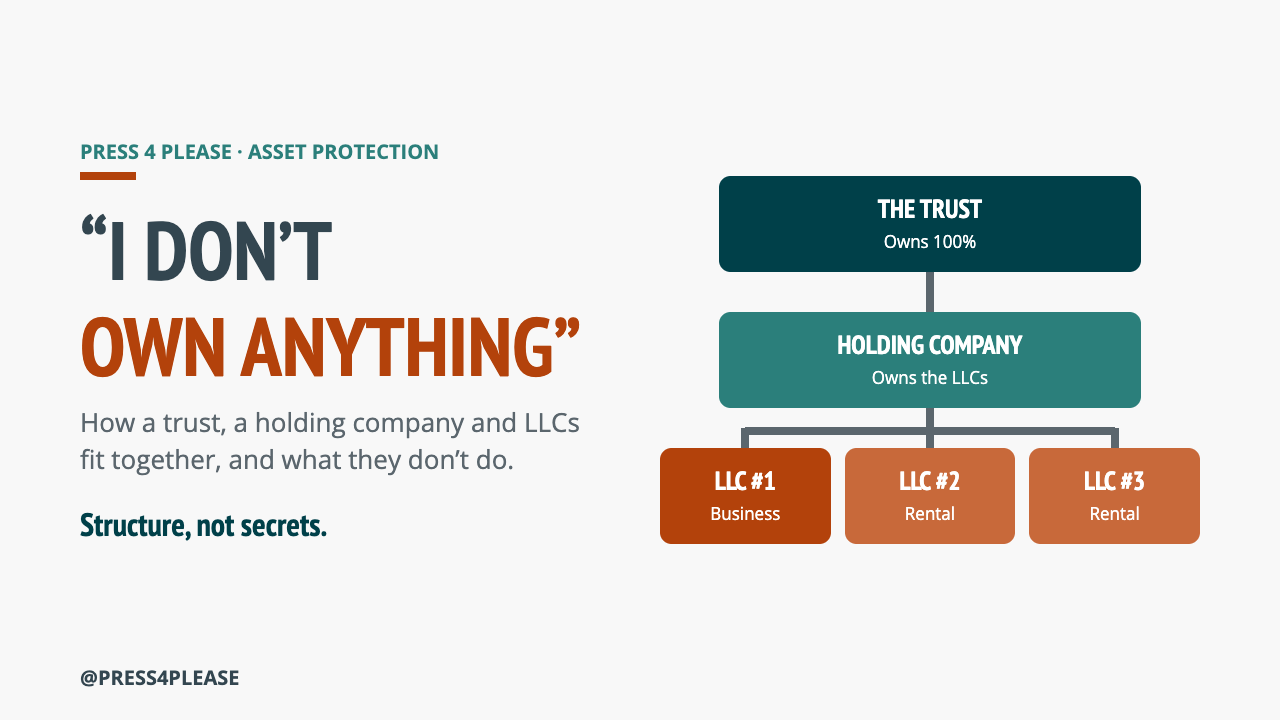
You may have heard a wealthy person say, "I don't own anything." It sounds like a riddle, but it usually describes a real setup: their assets sit inside a trust and a chain of companies instead of in their own name.
Here's how that structure works, what it actually does, and the parts social media tends to get wrong.
The structure in three layers
- The trust (top): owns 100% of a holding company.
- The holding company (middle): usually an LLC that owns the other companies.
- Separate LLCs (bottom): one for an operating business, and often one for each rental property.
On paper, the person doesn't own the business or the properties. The trust does. But with a revocable trust, they can be the trustee and still run everything.
Layer 1: the trust
There are two main kinds, and they do very different jobs.
Revocable living trust
- You stay in control and can change it anytime.
- Assets pass to your heirs without probate, the public court process that can be slow and costly.
- It keeps your estate private.
- It does not protect your assets from lawsuits or creditors, because you still control them.
- It does not lower your income taxes. The IRS treats the assets as yours.
Irrevocable trust
- You give up control to a trustee, and it's hard to undo.
- Because the assets are no longer yours, it can protect them from future creditors and remove them from your taxable estate.
- Most families never owe federal estate tax anyway: the 2026 exemption is $15 million per person.
Layers 2 and 3: the holding company and LLCs
Think of separate LLCs as watertight compartments on a ship. If one floods, the others stay dry.
- A lawsuit tied to one rental property generally stays inside that property's LLC.
- The holding company owns the LLCs, so one company's trouble doesn't spread to the rest, and you manage everything from one place.
- LLCs don't create tax savings on their own. By default, the income passes through to your personal tax return.
What this structure does and doesn't do
It can:
- Keep each business's risks separate
- Help assets skip probate
- Add privacy
- Make it easier to hand things off to your heirs
It can't:
- Make taxes disappear. It's not a tax dodge.
- Protect you from claims you cause personally, like a car accident
- Survive sloppy records. Mix personal and business money and a court can ignore the LLC (called "piercing the corporate veil").
- Run itself. Expect setup costs, yearly state fees, separate bank accounts and real paperwork.
Do you need this?
- Everyone: start with a will, updated beneficiaries and good insurance, including an umbrella policy.
- Own a home or have kids: a revocable living trust can help your family skip probate.
- Run a business or own rentals: an LLC can keep business risks away from your personal assets.
- Several properties or a large estate: talk to an estate attorney about a holding company or an irrevocable trust.
The takeaway
"I don't own anything" isn't a loophole. It's structure: separating risks, skipping probate and keeping things private. Start simple and add layers as your assets grow.
Follow @press4please for more simple money lessons.
2026 federal estate tax exemption per the IRS. Trust and LLC rules vary by state. This article is for general information only and isn't legal or tax advice. Talk to an estate planning attorney in your state before setting up any of these.
Want a head start?
Grab the free zero-based budget spreadsheet: give every dollar a job before the month starts.