How Much Money to Put in Each Account: A Simple 6-Step Roadmap
Nov 05, 2026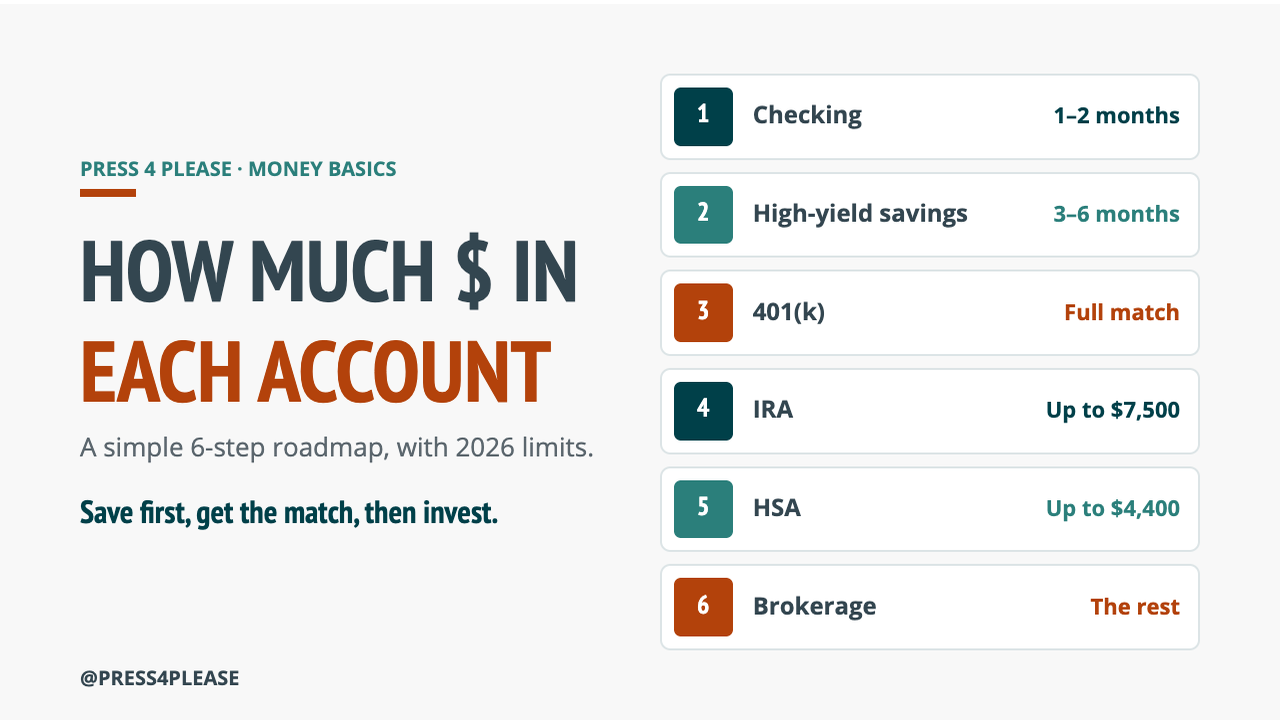
Once you have money coming in, the next question is where to put it. A simple order helps: cover your cash needs first, take any free money from your employer, use tax-advantaged accounts, then invest the rest. Here's a six-step roadmap, with 2026 limits.
Step 1: Checking, 1 to 2 months of expenses
Your checking account is for bills and everyday spending. Keeping one to two months of expenses there gives you a cushion so a big bill doesn't overdraw you. Much more than that is usually better off earning interest.
Step 2: High-yield savings, 3 to 6 months
This is your emergency fund. Most experts suggest three to six months of essential expenses, or more if your income is uneven. A high-yield savings account keeps it safe and easy to reach while it earns interest.
This is also a good home for sinking funds: money you set aside for costs you know are coming, like car repairs, holiday gifts or travel.
If you're carrying high-interest debt, like credit cards, paying it down belongs early in the plan too. Few investments reliably beat a 20%-plus interest rate.
Step 3: Your workplace plan, at least enough for the match
If your employer offers a 401(k), 403(b) or 457 plan with a match, contribute at least enough to get the full match. It's part of your pay, and skipping it leaves money behind.
- 2026 limit: $24,500 in employee contributions.
- Age 50 or older: $8,000 more in catch-up contributions.
- Ages 60 to 63: a larger catch-up of up to $11,250.
Matches and vesting rules vary, so check your plan documents.
Step 4: A Roth or traditional IRA
You can put up to $7,500 in IRAs for 2026, or $8,600 if you're 50 or older. That limit covers all your IRAs combined.
- Roth IRA: you pay tax now and withdraw tax-free in retirement. Income limits apply. For 2026, the phase-out starts at $153,000 for single filers and $242,000 for married couples filing jointly.
- Traditional IRA: you may get a tax deduction now and pay tax later. The deduction can be limited if you also have a workplace plan.
Step 5: A health savings account (HSA)
If you have an HSA-eligible high-deductible health plan, an HSA offers a triple tax advantage at the federal level: money goes in pre-tax, grows tax-free and comes out tax-free for qualified medical costs.
- 2026 limits: $4,400 for self-only coverage and $8,750 for family coverage.
- 2027 limits: $4,500 and $9,000, already announced by the IRS.
- Age 55 or older: $1,000 more.
Step 6: A brokerage account
Once the steps above are covered, invest what's left in a regular brokerage account. There's no contribution limit and no withdrawal rules, which makes it flexible for goals before retirement. You'll pay tax on dividends and gains along the way.
The takeaway
Keep a little in checking, build your emergency fund, grab the match, then fill your IRA and HSA before investing the rest. You don't have to finish one step perfectly before starting the next, but this order helps your money work harder.
Follow @press4please for more simple money lessons.
Limits are from the IRS for 2026 (and 2027 for HSAs). The right order for you depends on your debt, income, goals and benefits. This article is for general information only and isn't financial or tax advice.
Want a head start?
Grab the free zero-based budget spreadsheet: give every dollar a job before the month starts.