How Income Types Are Taxed: Employee vs. Self-Employed vs. Business Owner vs. Investor
Nov 06, 2026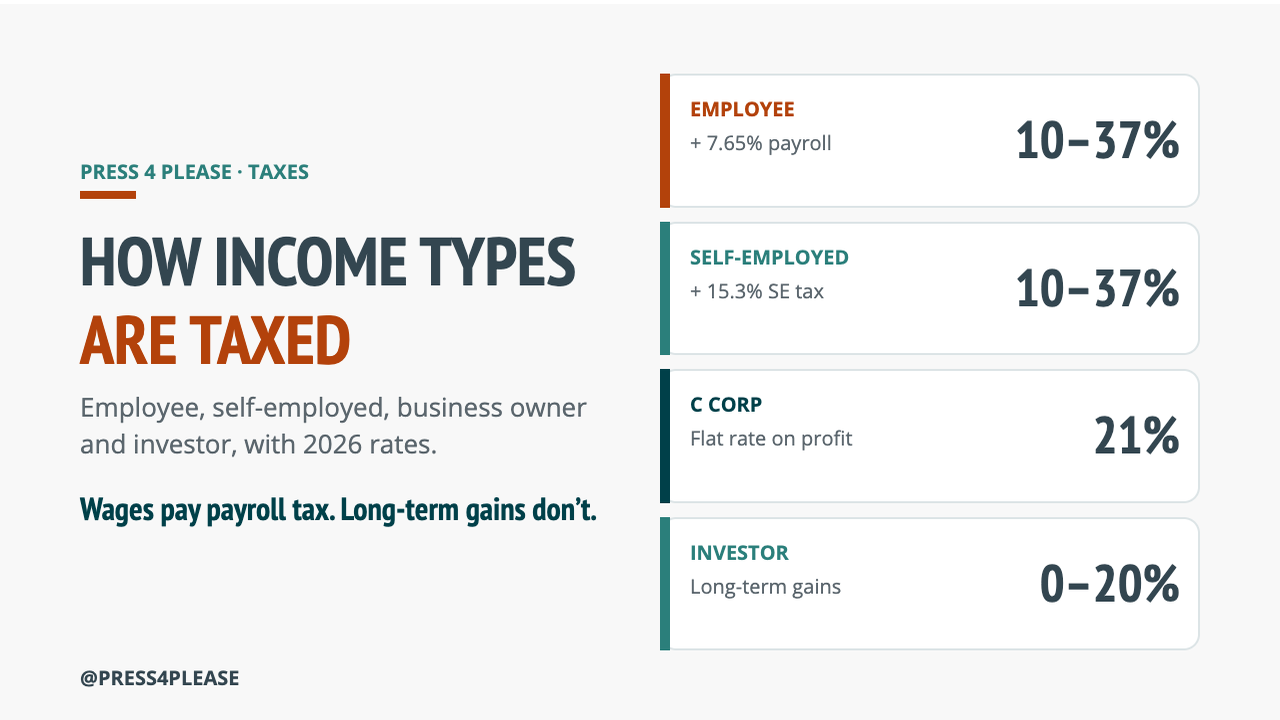
Two people can earn the same $100,000 and pay very different amounts in tax. The difference often comes down to how the money is earned: as wages, as self-employment income, as business profit or as investment gains. Here's how each one is taxed at the federal level in 2026.
1. The employee
- Income tax: wages are taxed at ordinary rates, from 10% to 37%. The 37% bracket starts at $609,350 for single filers and $731,100 for married couples filing jointly.
- Payroll tax: 7.65% comes out of every paycheck: 6.2% for Social Security on wages up to $184,500 and 1.45% for Medicare on all wages. Your employer pays a matching 7.65%.
- Ways to lower it: mainly pre-tax contributions to a 401(k), traditional IRA or HSA.
2. The self-employed
- Income tax: the same 10% to 37% brackets, but only on net profit after business expenses.
- Self-employment tax: 15.3%, because you pay both the employee and employer halves of payroll tax. You can deduct half of it.
- QBI deduction: many self-employed people can deduct up to 20% of their qualified business income. The One Big Beautiful Bill Act made this deduction permanent.
So self-employment brings more deductions, but a bigger payroll tax bill than a regular job.
3. The business owner
- C corporations pay a flat 21% on profit. Dividends paid to owners are taxed again on their personal return.
- S corporations pass profit through to the owners. Owners who work in the business pay payroll tax on a reasonable salary, but not on the rest of the profit they take as distributions.
- Deductions: ordinary and necessary business costs, like equipment, software and travel, reduce taxable profit.
The best structure depends on how much the business earns. Talk to a CPA before you change yours.
4. The investor
Gains on investments held more than a year are taxed at long-term capital gains rates, and there's no payroll tax on them:
- 0%: taxable income up to $49,450 single or $98,900 married filing jointly.
- 15%: up to $545,500 single or $613,700 married filing jointly.
- 20%: above those amounts.
Higher earners may also owe the 3.8% net investment income tax once income passes $200,000 single or $250,000 married filing jointly. Sell within a year and gains are taxed at ordinary rates, like wages.
Why this matters
Wages are taxed twice: income tax and payroll tax. Long-term investment gains skip payroll tax and often get lower rates. That's one reason building ownership and investments, alongside your paycheck, can lower your overall tax rate over time.
The takeaway
You don't have to quit your job to benefit. Max out tax-advantaged accounts, invest for the long term, and if you have a side business, track your expenses. Then talk to a tax professional about the mix that fits you.
Follow @press4please for more simple money lessons.
2026 federal figures from the IRS (Rev. Proc. 2025-32) and the Social Security Administration. State and local taxes are not included. This article is for general information only and isn't tax advice.
Want a head start?
Grab the free zero-based budget spreadsheet: give every dollar a job before the month starts.