Financial Goals by Decade: Money Milestones From Your 20s to Your 60s
Oct 29, 2026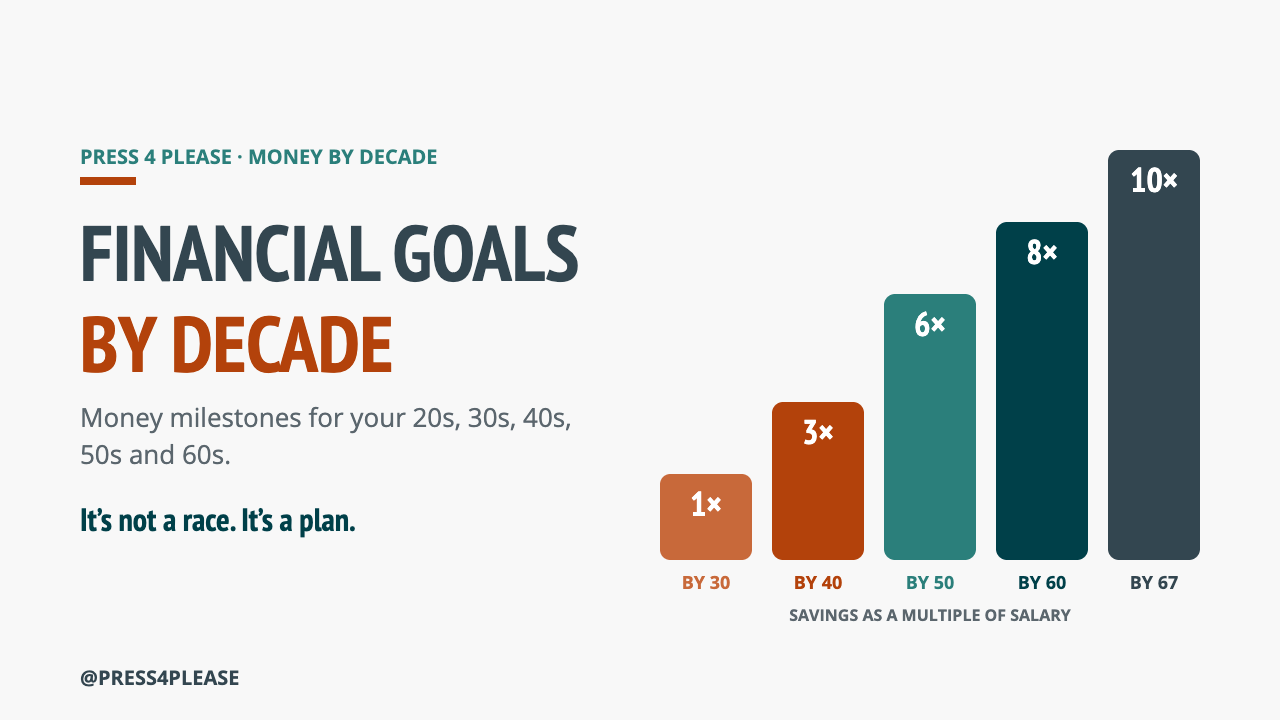
"Am I behind?" It's one of the most common money questions there is. The honest answer depends on your income, your goals and when you started. But having a few milestones helps you see where you stand and what to focus on next.
The savings milestones
Fidelity suggests these retirement savings targets, as a multiple of your salary:
- By 30: 1× your salary
- By 40: 3×
- By 50: 6×
- By 60: 8×
- By 67: 10×
So if you earn $60,000 at 40, the target is about $180,000 saved for retirement. These numbers assume you save about 15% of your income each year (including any employer match) starting at 25 and retire at 67. They're goals, not grades.
Your 20s: build smart habits
- Live below your means and track where your money goes.
- Build a starter emergency fund, then grow it to 3 to 6 months of expenses.
- Get your full 401(k) match if your employer offers one. It's free money.
- Avoid high-interest debt and get health insurance in place.
Goal: 1× your salary saved by 30.
Your 30s: grow stability
- Pay off high-interest debt like credit cards.
- Get the right insurance: health, disability and, if anyone depends on you, life insurance.
- Work your way up to saving 15% of your income.
Goal: 3× your salary by 40.
Your 40s: build security
- Max out your 401(k) and IRA if you can. In 2026, the 401(k) limit is $24,500.
- Save for your kids' college without skipping your own retirement.
- Review your investments and insurance once a year.
Goal: 6× your salary by 50.
Your 50s: strengthen retirement
- Use catch-up contributions. At 50 and up, you can add $8,000 more to a 401(k) in 2026, and $1,100 more to an IRA.
- Ages 60 to 63 can add a larger "super" catch-up of $11,250 to a 401(k) instead.
- Plan to enter retirement with no high-interest debt, and ideally a paid-down mortgage.
Goal: 8× your salary by 60.
Your 60s: secure retirement
- Plan your Social Security timing. You can claim as early as 62, but your check will be smaller. Full retirement age is 67 if you were born in 1960 or later. Each year you wait past full retirement age, up to 70, raises your benefit by about 8%.
- Enroll in Medicare around age 65.
- Update your estate plan: your will, beneficiaries and powers of attorney.
- Adjust your budget for retirement income, and consider part-time work if you want a bridge.
Goal: 10× your salary by 67.
Behind? Here's how to catch up
Most people are, so don't panic. These moves close the gap:
- Raise your savings 1% a year. Small bumps add up without hurting your budget.
- Pay off high-interest debt. Every dollar of interest is a dollar not invested.
- Use catch-up contributions once you turn 50.
- Work a little longer or wait to claim Social Security. A few extra years can make a big difference.
The takeaway
It's not a race. It's a plan. Start where you are, save a little more every year and check your progress every birthday.
Want a simple place to start? Grab our free zero-based budget template, and follow @press4please for more simple money lessons.
Savings guidelines from Fidelity, which assume a 15% annual savings rate from age 25 and retirement at 67. Contribution limits are for 2026; Social Security rules per the Social Security Administration. This article is for general information only and isn't financial advice.
Want a head start?
Grab the free zero-based budget spreadsheet: give every dollar a job before the month starts.