Chapter 1: Economics Is Really About Choices
Jul 28, 2026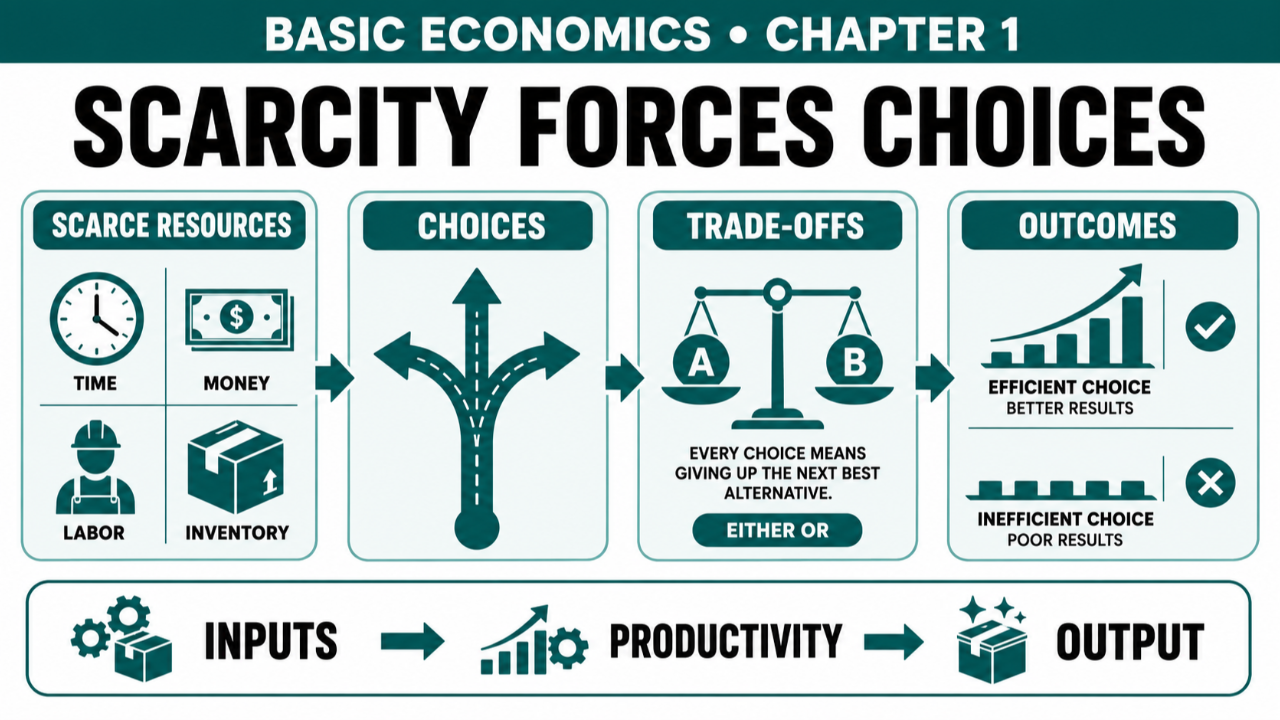
Press 4 Please Book Club: Basic Economics by Thomas Sowell
Before reading Chapter 1 of Basic Economics, I associated economics mostly with money, markets, inflation, and government policy.
Thomas Sowell starts somewhere much more fundamental: economics is about what happens when we have limited resources but unlimited ways we could use them.
That sounds simple, but it affects almost every decision we make—in business and in life.
Scarcity Is Not the Same as Poverty
Scarcity does not mean that something is rare, that people are poor, or that society has failed.
It means there is never enough time, money, labor, inventory, land, or other resources to satisfy every possible desire completely.
Even when our income increases, our choices do not disappear. We simply gain more options competing for that income.
I see this constantly in my own life. I have a full-time career, multiple businesses, a financial education brand, and no shortage of ideas. My problem is not a lack of possibilities. It is that my time, attention, and money cannot be committed to every possibility at once.
That is scarcity.
A business can be profitable and still face scarcity. A person can earn a good income and still have to choose between saving, investing, traveling, paying down debt, or starting something new.
The existence of a trade-off does not automatically mean we are "just getting by." It means resources have limits.
Every Resource Has Alternative Uses
The second half of the basic economic definition matters just as much: scarce resources have alternative uses.
One dollar can be spent, saved, invested, or used to pay down debt. One hour can be spent serving a client, creating content, sourcing inventory, or resting. One room can become an office, storage space, or part of a service business.
The moment we choose one use, we give up the others.
This has become especially obvious while building Press 4 Please. If I spend two hours creating a social post, those are two hours I cannot spend writing a course, improving my website, serving a pet-care client, or listing resale inventory.
The social post is not free simply because I created it myself. It still costs time—and that time had other possible uses.
Thinking this way forces me to ask a better question:
Is this the most valuable use of this resource right now?
That question applies to money, but it also applies to energy, space, inventory, skills, and attention.
Being Busy Is Not the Same as Being Productive
Chapter 1 also makes an important distinction between having resources and using them effectively.
A business does not succeed simply because it has money, inventory, employees, or customers. What matters is how efficiently those inputs are converted into useful output.
That hits home for me.
I can own hundreds of resale items, but inventory sitting untouched is not producing income. I can spend an entire day working on Press 4 Please, but if I constantly jump between unfinished tasks, the number of hours worked may not translate into meaningful progress.
The same principle applies to pet care. Filling every available space may create more revenue, but if it lowers the quality of care or creates an unsustainable workload, it may not be the most productive use of the business's capacity.
More input does not automatically create more value.
The real question is what we are producing with what we already have.
Economics Is Bigger Than Money
One of the most useful points in this chapter is that economics is not simply the study of money.
Money is a tool used to coordinate exchanges and measure value. The deeper subject is how people allocate real resources.
Sowell uses the example of battlefield medical care. A medical team may have limited time, staff, and supplies but several wounded people who need help. Even if no money changes hands, the team still faces an economic decision: how should those limited resources be used?
We make less dramatic versions of that decision every day.
A small-business owner must decide which customer needs immediate attention. A reseller must choose which inventory to purchase. A course creator must decide which lesson to develop first. A household must decide which expense takes priority.
Economics is not only about what something costs in dollars. It is about what choosing it prevents us from doing instead.
Intentions Do Not Guarantee Results
Another major lesson from Chapter 1 is that economic decisions should be judged by their consequences—not only by the intentions behind them.
A policy, price change, discount, or business decision can begin with a good goal and still create the opposite result.
I have learned this through pricing.
Charging less can feel generous and may attract more customers. But if the lower price creates more work without enough profit, the business becomes harder to sustain. Eventually, the quality of the service may fall—or the business may stop offering it entirely.
The original intention may have been to make the service more accessible. The actual result could be an exhausted owner and fewer available services.
This does not mean intentions are irrelevant. It means they are incomplete.
Before making a decision, we should ask:
- What behavior will this encourage?
- What happens after the immediate result?
- Who absorbs the hidden cost?
- Can this decision be sustained?
- What unintended consequences could follow?
That is economic thinking.
The Lesson I'm Taking Into My Businesses
The biggest idea I'm taking from Chapter 1 is that every business decision is an allocation decision.
I am always deciding where my limited resources will go:
- Which inventory deserves more capital?
- Which services deserve more time?
- Which content is worth creating?
- Which opportunities should I decline?
- Which parts of the business should remain small?
- Where will one hour of effort create the most value?
Saying yes to everything is not growth. Sometimes growth comes from recognizing scarcity, making the trade-off, and deliberately choosing where not to invest.
For me, that may be the most practical definition of economics: making the best possible use of what I have instead of pretending my resources are unlimited.
Chapter 1 Takeaways
- Scarcity exists because our wants exceed the resources available to satisfy them.
- Scarcity affects everyone, regardless of income or wealth.
- Resources have alternative uses, so every choice involves a trade-off.
- Productivity depends on how efficiently inputs become useful output.
- Economics is about real resources and decisions—not simply money.
- Good intentions do not guarantee good outcomes.
- Decisions should be examined through incentives, consequences, and long-term effects.
Book Club Discussion
As you reflect on Chapter 1, consider these questions:
- What is your scarcest resource right now: money, time, energy, space, knowledge, or attention?
- Where are you staying busy without producing enough meaningful output?
- What opportunity are you currently choosing—and what are you giving up to pursue it?
- Have you ever made a well-intentioned business decision that produced an unexpected result?
- What could you stop doing to use your resources more effectively?
Economics begins when we accept that we cannot have or do everything.
The goal is not to eliminate every limitation. It is to make better choices within them.