Paying Too Much in Taxes? Your 2026 Tax Reduction Checklist
Oct 17, 2026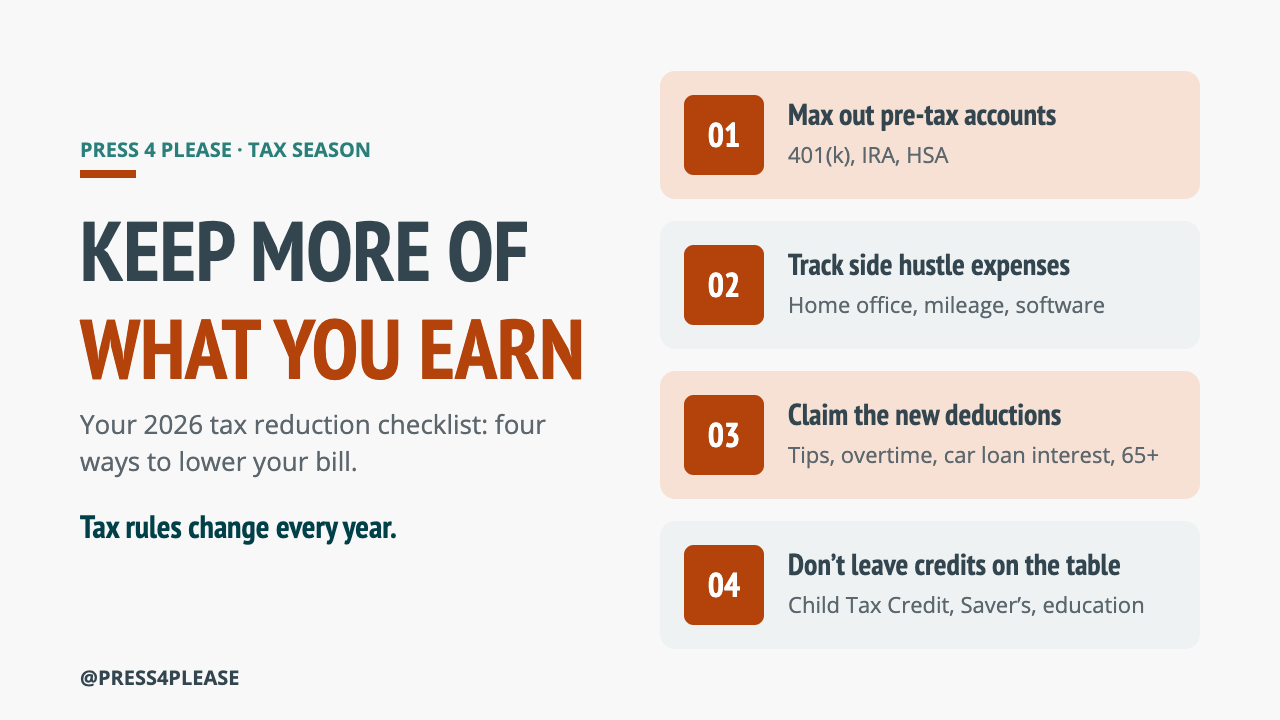
Are you paying more in taxes than you need to?
Most people only think about taxes in April. By then, most of the moves that could have lowered your bill are already off the table. The good news: if you start now, 2026 is a big year to get this right. The 2025 tax law added new deductions, retirement limits went up, and a few popular credits went away.
Here's a plain-English checklist to help you keep more of what you earn in 2026.
1. Max out your pre-tax accounts
Money you put into pre-tax accounts comes off your taxable income. It's the simplest way to lower your bill and build wealth at the same time.
- 401(k), 403(b) or TSP: up to $24,500 in 2026, plus an $8,000 catch-up if you're 50 or older.
- Traditional IRA: up to $7,500 (plus $1,100 if you're 50+). Whether it's deductible depends on your income and whether you have a workplace plan.
- HSA: up to $4,400 for self-only coverage or $8,750 for family coverage, if you have a high-deductible health plan. HSA money goes in tax-free, grows tax-free and comes out tax-free for medical costs.
- Self-employed? A SEP IRA or Solo 401(k) lets you put away much more than an IRA.
Your move: If your employer offers a match, get the full match first. Then raise your contribution by 1% to 2%. You'll barely notice it in your paycheck.
2. Track your side hustle expenses all year
If you earn money outside your 9–5, you can deduct the ordinary and necessary costs of running that business. Common ones:
- A home office (the business-use portion of your space)
- Equipment, software and supplies
- Business mileage and travel
- Your phone, internet, website and marketing (the business-use share)
- Business meals (generally 50% deductible)
Your move: Open a separate bank account for your side business and save every receipt. A simple spreadsheet or app works. Deductions you can't prove don't count.
3. Claim the new deductions for 2025–2028
The 2025 tax law (the One Big Beautiful Bill Act) created several temporary deductions. Most of them work even if you take the standard deduction.
- Tips: deduct up to $25,000 of qualified tips if you work in a job that customarily receives them.
- Overtime: deduct up to $12,500 of qualified overtime pay ($25,000 if married filing jointly). This is the "extra half" of time-and-a-half.
- Car loan interest: deduct up to $10,000 a year of interest on a loan for a new car, SUV or truck that was assembled in the U.S. and bought for personal use.
- Age 65+: an extra $6,000 deduction per eligible person.
- Cash gifts to charity: starting in 2026, deduct up to $1,000 ($2,000 if married filing jointly) without itemizing.
Income limits apply. The tips, overtime and car loan deductions phase out at higher incomes ($150,000 single / $300,000 joint for tips and overtime, $100,000 / $200,000 for car loans), and the senior deduction phases out above $75,000 / $150,000.
4. Don't leave credits on the table
Deductions lower your taxable income. Credits are even better: they cut your tax bill dollar for dollar.
- Child Tax Credit: $2,200 per qualifying child.
- Saver's Credit: a credit for low- and moderate-income workers who save for retirement.
- Education credits: the American Opportunity Credit and the Lifetime Learning Credit for college and training costs.
If you itemize, you can also deduct mortgage interest and up to $40,400 of state and local taxes (SALT) in 2026, with lower limits at higher incomes.
Heads up: some credits are gone. The federal EV credit ended for cars bought after September 30, 2025, and the home energy-efficiency improvement credit ended after 2025.
Key dates to put on your calendar
- December 31, 2026: last day for 401(k) contributions to count for 2026.
- April 15, 2027: deadline for 2026 IRA and HSA contributions, and to file your 2026 return.
- Quarterly: if you have side hustle income, you may need to make estimated tax payments.
The takeaway
Lowering your taxes isn't about loopholes. It's about using the accounts and deductions that already exist, and planning before the year ends instead of after.
Start with one move this month: raise your 401(k) contribution, open an HSA or start tracking your side hustle expenses. Then check in with a tax professional before you file.
Want help putting a plan around your money? Grab our free zero-based budget template, and follow @press4please for more simple money lessons.
Tax rules change every year, and limits and income rules apply. This article is for general information only and isn't tax advice. Check with a qualified tax professional about your situation.
Sources: IRS: 2026 retirement plan limits; IRS: One, Big, Beautiful Bill Act deductions.
Want a head start?
Grab the free zero-based budget spreadsheet: give every dollar a job before the month starts.